Resilience
Seeking Balance, and Allowing Resilience to Lead You Forward
When stress and anxiety are provided a window of opportunity into your heart, mind, soul and body, they quickly focusing on creating imbalance in your world in order to be able to invite their close friends depression, anger and frustration to the party. Seeking to find and keep your balance, and allowing your resilience to support you in moving forward, are ways to limit these windows of opportunity that tend to pull us even farther off the balance we seek.
Is there a sure-fire way to avoid stress, anxiety and their friends from attempting to tilt you over? Of course not, and yet, if you take action on several or all of these steps to build your resilience skills you will be better able to walk tall, keep your alignment more steady, and ward off these mental beasts that seek to tear you down.
A few simple excercises to stay in balance:
-Be thankful: Yes, be aware of what has been provided to you, what you have access to, and that you can use to take care of yourself. Be it food, shelter, clothes, or even crumbs, consider that you have something. If you have family, loved ones, a job, a place to call home, a place to visit, you have something to be thankful for, and
-Be kind: Taking a moment or two to provide an act of kindness, to care for someone else, or to provide something to someone that needs a pick-me-up.
-Be active: By getting your body going (walk, jog, run, ride, bend, stretch…) you inform each and every cell of your body that you are alive. You let your whole system know that this life must be lived, that you want to be part, and that you are readying yourself for your next great adventure.
–Be present: If you work, be at work, and take care of the things that work calls for without allowing yourself to be engaged in, for lack of a better word, “DRAMA” that pulls you away from your work. If you are at home, be at home, be there for those that need and depend on you, yes, that is your life, these are the people you love, and they deserve the very best of you each opportunity you have to be with them. By being present, you remain an active part of your life, their lives, and show them the way to engage, stay in control, remain calm, fight your way through, and to be ready for a new day!
–Build your skills: Personal, professional, creative, or even athletic skills must be targeted and focused on. If you recognize you should, and want to improve in a given area, you must put in the work to advance your skills. If it’s by becoming a better person, well, maybe you start by reading a little blog such as this, or it’s by taking a class, or it’s just by having a conversation with someone you know. If it’s professional, again, focus on the area of need, target that specific skill set you have identified, and get yourself going. If you want to develop a new part of yourself, there are literally millions of ways to “Google” it, and then take action. It is your life, you are the lead of your own show, and you can modify the script as you see fit.
BOLD CRAZY SENTENCE: You, are only the you, you believe yourself to be, and if you want to be a new you, well then identify a path, take a step towards your journey, and seek to become the new you you long for!
Here’s hoping that you each find your balance, that you seek to engage in being: thankful, kind, active, present, and that you build your skills accordingly. While I can’t guarantee that the stress and anxiety won’t be able to find you if you engage in these behaviors I can tell you with assurance that you will have more skills at hand in your resilience tool kit if you do, and that you will be more able to right yourself should you feel yourself tilting one way or another.
So, with that, Happy Thanksgiving to each and everyone, and I do hope that you reflect and plan on bringing the best you to each and every day. Remember, some of the best days of your life may have not happened yet.

Dr. Martinez is the Assistant Superintendent of Human Resources for the Fairfield-Suisun Unified School District and is also known as @ResiliencyGuy on @twitter. He can be found on Facebook at “Resiliency Guy” and is Co-Moderator of #Resiliencechat that occurs each Monday, at 7:00 PST on @Twitter
#Resilience Chat with Crystal Middle School Students, 10/28/16
Had a fantastic opportunity to share some thoughts about #resilience with some of our students at Crystal Middle School.
Some of the audio quality is not the best here, however I think that some of the video segments are pretty good examples of connecting to students, and that I was able to connect with them about what #resilience is all about.
I presented them with the concept that adversity comes in all shapes and sizes, and that I believe that if they have more #assets in their control that they will be better able to get through any roadblock that gets in their way.
I targeted four areas of development: #academic focus, #value development, social #competence, and #self-#empowerment as ways to build their personal #resilience skills.
I am hoping to hone this type of presentation, and I seek to reach more and more of our students, and possibly students across the states.
Let me know what you think.
Dr. Rob Martinez is the Assistant Superintendent of Human Resources for the Fairfield-Suisun Unified School District, and is known as @ResiliencyGuy on twitter, and throughout northern California. He is focusing more and more on sharing his knowledge on #resilience development with both #educators, #Students, and our broader educational communities.
#Resilience Reflection – Each Moment An Opportunity to #Inspire

As many of you might be aware I focus a lot on the issue of #resilience development, its importance as a personal skill for all, as an essential asset for our students, and as a trait that can be nurtured in each of us.
Well, I heard a story of a student at one of the elementary schools in my district, who, a few days ago was identified by a teacher as simply sitting alone during the day, when he should have been in class engaged in a learning opportunity. She explained that this boy appeared to be seemingly lost in personal thought, and possibly in need of a friendly smile or kind interaction. The teacher sharing this story with me said that she was drawn to this young boy to check on his welfare.
She shared that once she said “Hi” to him, he seemed to be generally fine, and though indeed, he was lost in thought, he came around after this brief interaction. He re-entered the learning environment, and this simple action changed the direction of his day. He readily accepted the friendly gesture, re-engaged in the lesson at hand, and enjoyed the remainder of his school day.
You might ask, what’s so special about that? Well, in my work as a school psychologist, as site administrator, and even as an administrator in Human Resources, I often try to focus on the little things that might go unnoticed in our day-to-day activities with children and with each other, and I seek to positively impact those little things to make a stronger impact on the big things.
What I noticed about this simple story was that the teacher telling me this story took notice. She noticed a boy, seeming lost to his thoughts when he should have been engaged in his class and learning opportunity. She noticed that he needed a kind, reassuring, guiding voice, to re-engage him in his learning environment, and she took action, and he responded. She noticed that a child, a human being, had removed himself from his opportunity to learn, place where he could advance his knowledge, participate with his peers, and have an opportunity to change his life, and she knew that she needed to make a difference for him. She didn’t wait for him to care before interceding, she took action!
Let me return to the story for a moment. At the end of that day, the boy was participating in class, connecting with other students, and even hugged this teacher prior to leaving for the day. A simple interaction by a teacher brought about a significant change to a situation where a student had removed himself from his learning environment. Indeed, this story could have gone so differently. If the teacher might have judged this child, took his detachment personally, or felt that some form of punishment was needed to “get his attention” this situation could have been escalated quickly, could have deteriorated this boy’s thoughts about education, and possibly confirmed for him that people don’t care. Again, it could have gone badly.
A few days ago I went by the school to meet this young man. I talked to him about his #resilience. I asked him about the other day, and he remembered. I shared with him that I thought that he had the power to make positive choices each day, and that he truly demonstrated resilience that day by returning to class, by participating, by taking hold of his own education, and that I believed that he has the ability to build on his success. I asked him if I could check in on him next month, and he said, “Sure.”
I share this story with you because I see it as a significant reminder that no matter where we work, no matter what our formal job or position is, that we can all work as individuals to positively impact our students every day. Whether it’s through a kind, reassuring, guiding voice, whether it’s by providing the most engaging lessons and instruction that we can each day, or even if it’s safely driving our students to and from schools if we are a bus driver, we can all positively impact our students. We can all afford a smile, a kind word, a positive engagement moment, or even simply by lending an ear to a child. It doesn’t cost a lot of money to be #kind, #compassionate, #empathetic, and to make a connection. In fact, it cost nothing at all, except for your time and energy to do so.
I challenge you to take advantage of each moment that you have with children/students and let’s strive to make a connection with them whenever possible. I implore you to let children know that you care, and that you are there to assist them in building their personal skills and assets, especially their #resilience.
Each Day an Opportunity to #Inspire!
Dr. Rob Martinez is the Assistant Superintendent of Human Resources for the Fairfield-Suisun Unified School District, and is known as @ResiliencyGuy on @twitter He strives to build the capacities of his employees in fostering #resilience across his District. Follow Dr. Rob at @ResiliencyGuy on #twitter and #intagram, and on Facebook at “Resiliency Guy”
Focus on Transformational Resilience
My focus is on #Resilience development, and my concept is simple to comprehend. I believe that each person has the capability to support others with developing #resilience skills. I also firmly believe that it is an obligation for adults, especially educators, to build environments for children, and especially their students, that foster the development of the latent ability to be #resilient that resides in each child.
I believe that there are steps that each person can take to support the advancement of #resilience skills, and this simple graphic is representative of those actions that can be taken to build these skills in our children.
Ask yourself these questions and reflect if you are taking steps to build or hinder #resilience development:
1. Am I acting to #engage my students? Meaning, Am I offering relevant interactions that are intended to build their skills, knowledge, creativity and innovation skills?
2. Am I offering #positivity to my students? Meaning, Am I focused on the growth, the development, the advancement of my students, while providing authentic meaningful feedback that encourages my students and inspires them?
3. Am I being #thoughtful in my approach with my student? Meaning, Am I considerate of the unique needs and interests of my students, and I am reflective in my process, and then, in turn, able to be flexible in my approach to connecting with them as individuals?
4. Am I #supportive towards each of my students no matter what? Meaning, no matter the needs, no matter their behaviors, no matter the trauma that they may have been exposed to, do you accept them, without reservation, and do you recognize that they deserve the best you can be?
I believe that working to support our children is the most important work that can be accomplished by educators, parents, and adults. If we don’t, who will? If we don’t act, how will our children learn and grow? If we don’t accept this responsibility, act as mature, well-functioning adults, how in the world can we expect our children to become more advanced well-functioning adults? It is that important! It is the most essential work that we can do! It is up to each of us to build environments for children where they can grow, flourish, and activate the latent ability to be resilien! Please join me in this effort to help our children grow in peace!
Dr. Rob Martinez is the Assistant Superintendent of Human Resources for the Fairfield-Suisun Unified School District, and is a proponent of supporting #resilience development in all of our learning environments. He would be happy to assist you and your schools in building and fostering environments where #TransformationalResilience can grow!
You can follow Dr. Rob at @ResiliencyGuy on #twitter as well.

Transformational Resilience: Putting the Puzzle Pieces Together!
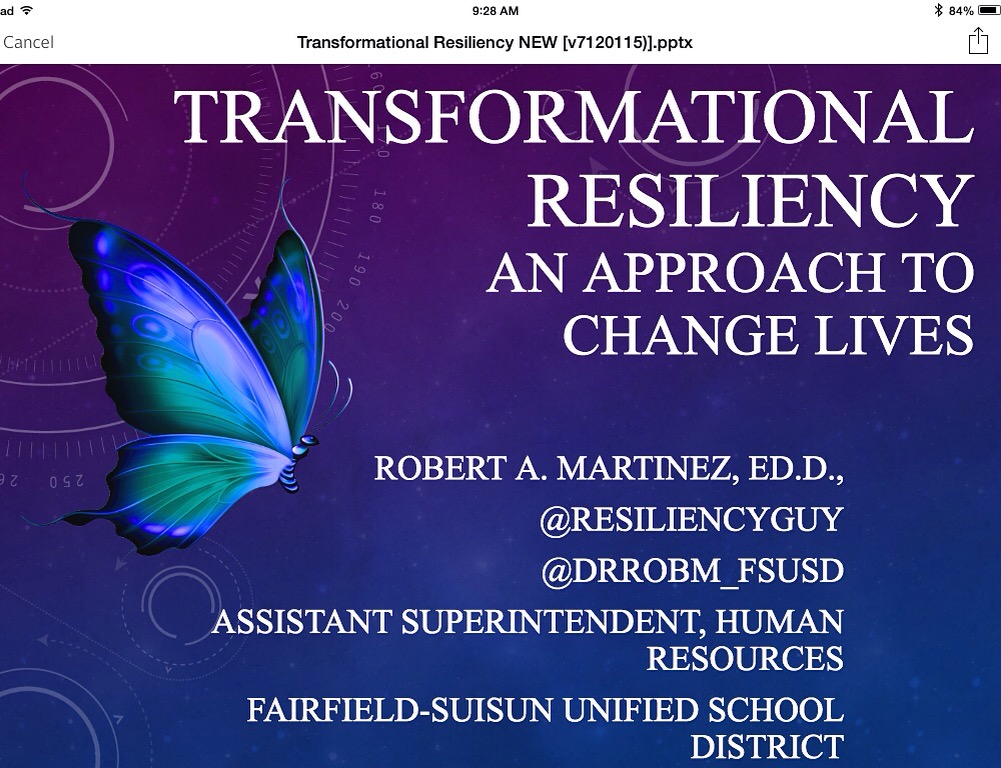
Resilient Individuals:
Individuals who demonstrate resilient behaviors tend to be able to recognize and manage their personal perceptions and feelings, and are cognizant of their personal locus-of-control. They can perceive and understand feelings of others, understand that they matter to others, and also see that they can make a positive impact on the world. They tend to believe in themselves, reach out to others when required, and accept help from others. They insulate themselves from self-blame, and deprecating behavior, make peace with negative events, and live a healthy life. Meaning they eat well, get their rest, excercise, and accept change.
The tricky part is of course building environments that support and promote health living, engage minds, create places where these skills can develop and flourish, and where resilience thrives! Is it doable? Can we create healthy environments where it becomes the norm to develop resilience skills? I surely hope so, and with some specific strategies we can all be on our way to these types of schools!
Action Steps For All Educators, Parents, Students:
-Encourage the Development of Positive Attitudes: By connecting with students, and providing positive feedback, encouragement, connections, and communication we can elicit healthy responses. We can keep barriers from building that stifle growth, positive attitudes from developing, and connections with other people from propelling students forward.
-Increase Support Networks for All: Ensure that each person in the environment has someone to be with, talk to, chart with, share with, and create a culture where listening to others is a premium behavior that is rewarded, over and over again. How many times do we see students talk at each other without really listening? The skill of listening has been demonstrated to be a consummate winner in evolving our societies. Listen people, just listen!
-Encourage the Building of Trusting Relationships: By fostering mutual respect for each other as people first, whether the relationships is between students, students/teachers, parents/teachers, etc. It is imperative that we build a culture where each one recognizes that we are there because of the others that are present. An old South African saying, “I am because you are,” shared often by Bishop Desmond Tutu, means that I exist as part of your world, and we are in this together. Let’s build schools where we are all in this together!
-Increase Student Engagement: We must build schools and deliver instruction for the students we have, and in response to their needs. We must be flexible in our methods, styles, instruction, curriculum, performance, measurement of success, supports, and work to provide meaning to the learning that matters to our students. If we continue to treat students as they have always been treated, then why would we expect a different result? The time is ripe for change!
-Foster a Positive and Inclusive Ethos: Our students need to be connected and belong to their environments. Hence, we must work to ensure that each student not only feels a part of their school, but that they truly identify themselves as being part of the school. By including them in decisions, acting on their interests, celebrating their diversity and uniqueness, and authentically connecting with them first as people, than as supporters of their development we provide more opportunity for them to belong to, not just attend school.
-Enhance Extracurricular Activities: The days of after-school sports need to be modified in order to provide both #Access and #Equity to all students. During the day school clubs, technology, activities, sports, visual and performing arts, drama, (and the list goes on), must become a thing of the present to support our students with having opportunities to engage, connect with, and pick up a multitude of talents. Especially for our students who may be marginalized, and/or who cannot afford after-school activities, we must ensure that their opportunities are provided and enhanced!
-Make it #FUN at Every Level: Schools, school communities, classrooms, extra-curricular activities, staff meetings, must all have a component of fun! If not, then what is the purpose, really? As humans, we laugh, we giggle, we smirk, we guffaw, we snort, we are silly beings, and if we are not engaged and having fun, we generally look for something else to do. So why, not? Why not make it all fun? Why not take your class outside to hunt for moon rocks (ala Dave Burgess, “Teach Like a Pirate” guy? Why not bring some wild music into the classroom, and see how it livens up the place? Why knot? (The word knot was used to see if you were paying attention, and to make you laugh!)
-Develop Life Skills: Possibly through internships, service-learning, taking leadership roles in the classroom, or at school, or volunteering to help younger kids read, or by simply being a buddy to another student, there are ample ways to help students realize that their life skills matter, that they can have a positive impact on people in their worlds. As students develop it could become so easy to simply allow each one to believe that they are the most important child in the world, and if we work just a little bit, we can help them realize that they could in fact become the most important person in the world to another person who needs them. If we did, we sure would have some tremendously skills children on our hands.
Summing up: I do believe that as educators come to not only recognized the need for these types of supports, and that we collective begin to act on them to build the types of schools that are surely needed, we can positively change the world, one student, one classroom, one school at a time. And, if we really get to it, we can change our communities for the good that much faster!
Dr. Robert A. Martinez, AKA “Resiliency Guy” on Facebook, and @ResiliencyGuy on #twitter @twitter strives to support the ideas of Transformational Resilience #TR to all who come in his path! He co-moderates #Resiliencechat on Monday evenings on #Twitter at 7:00 PM PST. Join him in his quest to create schools where children can “Grow in Peace!” He is currently the Assistant Superintendent of Human Resources for the Fairfield-Suisun Unified School District.
Re-examining #Resilience
Take a moment and consider your current understanding of the word “Resilience.”
A Question:
Do you consider your understanding of #resilience to be deep, or surface level? It seems that in our day-to-day culture the word has become more of a descriptor of character or action, rather than as a true understanding that the word more accurately describes a person’s ability to persevere through an adversity, a challenge, a trauma, a life-changing circumstance, and to demonstrate a strength in their resolve that comes from the experience.
What is true #resilience?
It’s not just about winning a sporting event, or getting through a test, or even making it through a day. It’s more about having and demonstrating the ability to recognize that whatever the adversity was, or is, was more than likely not a personal descriptor of the individual experiencing that adversity, but something that has occurred to them, that they have dealt with, and have learned from. Resilience is about overcoming, battling through, surviving, and growing from adversity, and limiting the negative impacts from derailing future success for that person.
What does research say?
Researchers have recognized the ability of an individual to reframe events so that they do not internalize them, and use the adversity as a means for growth and success. For many people these challenges are recognized as launching pads for new ideas, new strategies, new ways of acting, or for new ways to limit the impact of adversity from negatively affecting themselves any longer. The stories are numerous of those individuals who have come through adversity, and who then have not only improved their lives, but the lives of others.
Locus-of-Control
Further, it has been found that those that demonstrate resilience tend to have a firm locus-of-control on where the problem exists, how it came about, and they are able to distance themselves from the trauma. Now, this doesn’t mean that people don’t feel the pain from trauma, or are not affected by it, yet they tend not to own it, ruminate over it, and allow it to remain in their frontal lobe exhausting their energy, resources, thought process, or ability to move forward.
Reframing Skill
So, if the ability to maintain a powerful locus of control, and to reframe events to be able to limit their negative affects on us are two assets that can be utilized to build resilience, then why wouldn’t we seek to support the development of these skills in our children and each other. If people can learn to reframe, if they can distance or remove themselves from traumatic events, then they have more of an opportunity to demonstrate resilience, and to enhance this skill for when they will need it in the future.
Variance
We know that one person’s challenge is another person’s trauma, and that each person may react differently to the same circumstances, and in turn may react on different timelines to trauma, and this makes the point even more important that we must seek to build the resilience of our children, and each other, each day, for we never really know when the next traumatic event might initiate a down-turn for ourselves or someone in our world.
The challenge
Let’s build each other up! Let’s build skills in each of our children! Let’s build resources in our communities! Let’s share the message of supporting the development of Resilience skills in our children! Let’s focus our energies on engaging, supporting, and providing the healthiest environments that we can for all of our children!
Are you with me? I hope so!
Robert A. Martinez, Ed.D, @ResiliencyGuy on Facebook: ResiliencyGuy
Dr. Martinez is the Assistant Superintendent of Human Resources in the Fairfield-Suisun Unified School District, and has been focusing on building the idea of Transformational Resilience in people, our schools and our communities. He also co-moderates #Resiliencechat on #twitter each Monday night at 7:00 PM PST.

Gratitude, Appreciation and Thankfulness
Gratitude, Appreciation, and Thankfulness

Gratitude, appreciation and thankfulness are personal characteristics that many people have, and I believe that when people allow these characteristics to frame their perspectives they are often more happy within themselves, and about their lives.
I believe that our perspectives are skewed by our experiences, and it is our interpretation of those experiences that provide us the ability to reflect, consider, and then to build our true life perspective that we then use to live new experiences.
A few difficult questions for you as you consider self-reflection: How were your world interpretation skills developed? Do you work on them? Do you reflect on them? Do you simply believe you are correct in your perspective? Do you seek out new ways of thinking? Do you seek out other views to be able to broaden your personal awareness? Do you believe that what you believe should or should not be questioned? Do you seen an alternative to your perspective, and can you view yourself holding that perspective?
To get more to the point, do you hold gratitude for the people, experiences, and life that you hold? Do you really appreciate the people, experiences, and life that you have built? Do you demonstrate your thankfulness to the people who have been and are in your life, for those experiences that you have had that have built who you are, and do you seek to pay it back to those in your world in a positive way?
To grow, develop, and to positively change takes time, and if you actually want to understand and appreciate your life in a more introspective way, it takes conscientious thought, consideration, reflective capabilties, and an understanding that life isn’t what has been done to you, it’s a compilation of the people that have been in your life, the experiences that you have had, and your responses to both.
Yes, you build your interpretation frame. You have the ability to analyze, interpret, and add meaning to each event. Now, sometimes, as children, we have limited abilities to control the people that come into our lives, or the life experiences that we have endured, and yet, as we review, interpret, and add meaning to these experiences as we grow, we can adjust, be flexible, and help ourselves to grow, develop, and take charge of our lives.
I choose to be grateful, to appreciate life, and to offer thankfulness for the people, experiences, and synthesis of both into my life. I choose to believe that I can make a difference, help build a positive world, and work to connect people to the resources that are close at hand that just might help them to grow, develop, and live healthy lives.
Is it a simple trick, is it a simple approach, is it simply that easy? Gratitude, appreciation, and thankfulness, three key ingredients to consider on this Thanksgiving Day, and I hope that you choose to sprinkle liberally throughout your life.
Dr. Rob Martinez, known as @ResiliencyGuy on twitter and “Resiliency Guy” on facebook, strives to connect with people and supports the framework of “Transformational Resiliency.” He will be presenting at the National Conference on Resilience Education in Las Vegas, Nevada on December 5, 2015.
Connect, Appreciate, and Build a Sustainable Transformation
Connect, Appreciate and Build a Sustainable Transformation

Connecting: When we connect, even for a moment, we demonstrate the ability to build relationship, be human, show love, and to build a community.
When we connect with those in our environments we take the first step in demonstrating to them that we care, that they matter, and that we believe in the value of them as a person with individuality, ideas, and thoughts that matter to us. We tell them that not only do we care about them, but they have a place in our world, and in our collective reality. Whether this connection is a simple acknowledgment, a wink and a nod, a brief conversation, or a heartfelt hello, we must strive to ensure that we are making these connections.
Think about it, in your world, when people take that moment to actually connect to you do you feel more alive. I think that as we go through our busy days, we often become so consumed eith our internal thoughts, our minds focused on problem solving, and with gathering information from our technological devices, that we sometimes forget to recognize that others are seeking to connect with us. For example, as I was ruminating over my day’s work, driving home, stopped at a stoplight, with the news radio blarring at me, I happened to look to my left.
It took just a few seconds, and yet there she was. An elderly African American woman I didn’t know, sitting in the passenger seat of the car to my left. She smiled, gave me a little wave with her small right hand, and nodded to me. It was no more than a few fingers being lifted to let me know that she saw me, and that smile and nod refocused me into realizing that my work-day, though long, filled with the troubles of others, and with complex problems with solutions that were hopefully on their way, was actually not that bad at all. She let me know that she saw me, she connected with me, she ackknowledged my exsistence, and I was grateful.
Appreciation: If we miss a moment to show appreciation, we miss an opportunity to potentially change the world! Don’t miss those moments!
Do moments in your day seem to fly by in clusters where you move from cluster to cluster without recognizing the efforts of others? For me it happens all too often, and I want to be better at recognizing the efforts of others, then in demonstrating appreciation for the efforts of others. This will take a conscious deliberate effort in seeking to notice these efforts, and a purposeful response to demonstrate that I’ve noticed, and appreciated those efforts. Please consider joining me in these efforts.
It could be as simple as saying, “Thank You.” It could be as simple as writing a post-it-note with a smile on it, and leaving it in a conspicuous place for the person to find, or it could be a brief email, text, snapchat, tag in a twitter post, or any other entry into the technological stream that the person swims, to let them know that you noticed, and appreciated their efforts. The venue isn’t the important thing, it’s ensuring that the person that you want to demonstrate appreciation for realizes that you care, you noticed, you appreciate them, and that you are not taking for granted their efforts.
Our world today is moving so fast, and yet, it is these moments that are so important to us as people, and it is these moments that could actually make an impact on our personal story, the story of the people in our world, and the broader world in general. Consider how your reality might change if you offered more appreciation to others. Could you ingnite a new way of acting with people in your reality? Could this new way of acting spread to those people, and their realities? Could we, as some have said, actually change the world by initiating a “Chain of Appreciation” that links us all together? What if we could? Why wouldn’t we?
Building a Sustainable Transformation: This takes ideas, dedication, and follow through! #Resilience #EachPersonMatters
To change the world is no easy feat, and yet, what could be more meaningful? So to those that actually dare to take on this challenge with me, I say, “Welcome, to wherever you are,” and “Let’s travel this journey together.” Whether you are a teacher, an educator, a person who cares about others, or the head of a major corporation, it just doesn’t matter, since no matter who you are, you do have the ability to change your world, impact the world of the people within your world, and quite possibly, change the entire world.
You simply need ideas that you believe in, dedication to initiate a change in your own behavior, and perserverance to follow through on your own behavior. In addition, if you create opportunities for others in your world to follow your example, and set expectations for those in your world that will lead to them supporting your ideas, then your goals become closer to your reach.
As this blog suggests, if you seek to increase your personal connections with others at every opportunity, if you begin to increase your appreciation for others that you are connecting with, you will be taking significant steps to build a sustainable transformation in your world, that can, and will, impact those in your world, and quite possibly ignite a change to our collective world. I ask again, What if we could? Why wouldn’t we?
Peace, Rob Martinez, Ed.D.
Dr. Martinez, strives to empower adults to build environments for children where they can “Grow in Peace. He can also be found on twitter as @ResiliencyGuy and @DrRobM_FSUSD
Dr. Martinez will be presenting at the American Associationi of School Personnel Administrators Conference, “Human Capital Leadership Summit” in Monterey, California, on December 3, 2015, and at the “National Conference on Resilience in Education” in Las Vegas, Nevada, the weekend of December 5-6, 2015.
Refresh, renew, rekindle, reflect, and recharge those batteries
I think that each person has an unlimited ability to bring positivity to the world, and yet, if each of us gives, and gives, and gives without taking time to recharge our batteries we do run the risk of running on emply, and sputtering out like an old VW Bug. Thus, it is important for each of us to refresh, renew, rekindle, reflect and recharge those batteries.
Refresh
Each of our journies is important, and yet, if we stay on the same course for too long we run the risk of running ourselves into a rut. We must remember to pull to the side of the road, take a pit stop, small the flowers as they say, and heck, even eat a candy bar. It’s the simple pats of our lives that can become so important to refreshing our spirit, our palate, and our perspective of the world. Maybe your choice will involve a smooth bottle of red wine, an oyster or two, or even some freshly cooked french bread, just remember to take that moment, breathe, breathe again, and smile before you get back on your journey.
Renew
Have you done something new lately? Tried painting, sung a new song, karaoke perhaps, or even taken a new route though the grocery store. It might seem so simple, yet having a new experience, or even changing up an old experience can lead you to see things in a differrent way. Our eyes, senses, brains are all looking for new ways to see things so give them the experiences they desire. By keeping things fresh we offer ourselves new growth opportunities.
Rekindle
Have you taken a step back, and considered why you do the work you do? Is it just for a paycheck? Is it just a job? Or, have you found your passioin? Or, do you remember why the work you do is your passion? Or, do you need to find a new passion in the work you do? Simply put, your passion should guide your work, and if it doesn’t, take some time to rekindle your passion, or find a new passion in your work, or find new work that you can be passionate about. My dad once said to me, “If you do what you are passionate about you will never work another day in your life.”
Reflect
Upon review It might seem just a bit selfish to consider refreshing, renewing, and rekindling your life, and yet, the practice of reflection is so essential to mindlfulness and growth, and is of paramount importance to self-actualization. For those that don’t take time to reflect they run the risk of self-presumption, and potentially false confirmation that what they have done or are doing is always right. While those that take the time to reflect on their actions, their choices, their thought patterns, and their lives, place themselves in a better place to change things for the better. Remember, reflection doesn’t mean that you have to review everything, and change it all! It simply means that you give yourself time to consider things and determine how you can improve parts of you personal puzzle for self-improvement.
Recharge
Believe me, I am not perfect, and often I am one of those folks that doesn’t give themselves the opportunity to refresh, renew, rekindle or reflect, and I can absolutely feel my batteries getting drained as I drive myself into a rut. I have realized that I find it difficult to sustain a super high energy level with no rest, and I need to be reminded to slow down, take a pit stop, smell the flowers, eat a candy bar, and enjoy it wirh a smooth bottle of red wine.
Remember, it’s okay to give, and give, and give, just understand that its also okay to give yourself some time as well. You will be glad you did.
Dr. Rob Matinez is the Assistant Superintendent of Human Resources for the Fairfield-Suisun Unified School District, and is a Board of Director for the Association of California School Administratorscan. He can also be followed on twitter as @ResiliencyGuy and as @DrRobM_FSUSD
Shared World
Image Posted on
Shared World
This post is dedicated to Matthew M. Martinez, and Rayne Jane Winter-Day, two young adults who are seeking to understand some of the issues surrounding #Ferguson, and the broader implications for our society. Whether you believe in the cause, believe in the protests, believe in the mass media reports, believe in the injustice, or believe justice has been served, I hope to get you to question your understanding of some of your current believes about our “Shared World,” and to realize that you have a part in building shared sustainable solutions. Do I have all of the answers? Absolutely not, yet I hope to bring to you some more questions that hopefully will allow you to consider various perspectives, which I always believe will lead to personal and compelling growth. It is all about each one of us, our effect on each other, and it is always personal!
We All Share this World: So Why Not Have Shared Ideas, Shared Responsibility, Shared Understanding, Shared Sustainable Solutions to Salvage our Humanity?
We all understand that we have but one world we live in, and yet, in each of our arenas, we often believe that we live in the one “right” world. We also often apply our perspectives to not only our one “right” world, but to the multituude of worlds that actually exist. Thus, it is often extremely difficult to fully understand the complexities of events that are occuring outside of our world as we tend to apply our perspectives, our ideas, our understandings, and our thoughtful solutions onto that world with hopes that we can fix every situation. I offer this piece with the hope to expand perspective, ideas, responsibility, understanding, and sustainable solutions that can be shared my humans of multiple perspectives across multiple communities. I believe that as individuals, as collaborators, as builders of communities we can act as individuals and as groups of people to improve our collective and shared worlds.
In our recent shared culture many individuals have taken the dangerous step of generalizing the behavior of some onto the masses of a group due to a presumed shared characteristic. This process becomes presumed sterotyping. For example, individuals who more often than not good people, with good intentions, who, with good training and professional development, with skill enhancement, and specific education may become attached to a profession that has become discredited, and or disparaged by our society and broad scope media. Consider theses professions: police officers, teachers, lawyers, politicians, the list could go on and on. For the multitude of individuals who might have made decisions at an early age to become a member of each of these professions, do you really believe for a moment that all of their individual decisions were made with ill-intent? Do you really believe that someone truly set out upon a specific course to become the worst their is in their profession, or on the other hand did they make a conscious choice to serve, serve the public, serve people, serve their communities, serve with positive intent with the hopes of making a difference?
In each of these professions, and in others far too many to list here, what our shared reality should tell us is that the vast majority of these professionals strive to do their jobs appropriately, to work for the betterment of our shared society, to keep their behaviors within the parameters of legality, hold onto their integrity, and actually believe that their impact on society is a worthwhile endeavor. Unfortunatley, due to some of the negative or inappropriate actions from some within each of these small minority of wrongdoers within each of these professions, coupled with a lack of informed, forward-thinking, progressive leadership at the helm of some of these groups that they belong, the entire collective of a profession can and does easily becomes a target for the masses especially at the hands of the mass media.
Consider that number of media stories that are provided time on the major news channels. Many, if not all, are filled with negativity, are focused on wrongdoers who may have absolutely done inappropriate things, and that are played over and over ad-nauseum with added conjecture, embellished truths, and half-truths. This type of media coverage, when left unquestioned, could lead us to believe that the only things occurring in our world are these negative events, over and over, and over again. What we don’t see are 95% of real life activities that the majority of public servants are engaged in on a daily basis, or for that matter general people. What we don’t see are the heros that are taking care of children, the aged, the weak, the poor, and working to protect all people of a community, all people at the mall, all people at the park. What we don’t see displayed are the acts of human kindness, thoughtfulness, positively purposeful acts that the vast majority of public servants provide to our collective communities at any given time. What we forget is that just because we didn’t see it on CNN or FOX, or whatever, doesn’t mean that it didn’t happen. What we forget is that most of these heroes go through their days, time after time, with limited acknolwedgement, little fanfair, little more than the meager pay that is provided to them for their service doing what is right!
Could it be that we have allowed the media to take advantage of our ability as humans to be manipulated? It is so easy for our minds to accept the presented stories that convey negativity that most of our public servants are engaged in inappropriate activity, rather than to understand that most are well-intentioned, positive, caring individuals, who with the training they have received are attempting to do a really good job? Could it be that each of us shares a part of the responsibility of recognizing that this could be the truth, and that we actually should become the tellers of the positive story? Shouldn’t we seek to share the positivity of our public servants and provide positive feedback for those that are doing it right? Could it be that by sharing stories of actual positive events, and positive works by progressive organizations, we could actually empower much needed change in the leadership of some of our worst wrongdoers, and build support for those organizations and individuals who are doing it right?
Please don’t get me wrong. Where there is malfeasance, where there is inappropriate behavior, where there is wrong-doing, it must be recognized and corrected. Where there is prejudice, discrimination, degredation, and dishonesty, it must be ferreted out, and fixed, and for those individuals and for the organizations that have fostered these types of innapropriate behaviors to occur, there must be change, significant restorative practices to fix what is wrong, and a true commitment to improve what is wrong, and real efforts to make things better.
Quite frankly, there must be intentional, purposeful, thoughtful, supported, actionable, planned change that has been provided resources applied to that change! Does this change start at the top? Should it be embedded in the collective leadership? Should it be fostored throughout the organization? Should there be a way to measure and monitor this much needed change? The answers are of couse, yes! Should the change needed be discussed openly, discussed across the stakeholders of the community, and then embedded throughout a continuum of change that will be clearly recognized as the resulting change? Yes, of course! Can each of us begin to understand the importance of seeking to declare the need for such change in our lives, our communities, our organizations, and do so by appropriate measures without infringing on others rights that we are actually seeking to protect? Yes, I hope so!
Perspectives collide:
I understand that for many in our society, there is mis-trust. Mis-trust of public servants, mis-trust of the organizations in which they work, mis-trust of the leaders behind these organizations, and mis-trust of any form of government. Some of this mis-trust is well earned, and some maybe not. On the other hand, there is some growing mis-trust that is now felt on the part of the very public servants that are committed to supporting our society. Our public servants have mis-trust of the media, who tend to report on the negativity as discussed above, mis-trust of the leadership that guides their organization sometimes with hidden agendas, and dare I say, some mis-trust from those they serve, who will often mis-judge their intent, and tend to believe the negativity without seeing the reality of their positive efforts.
I suggest that there must be new perspective building, new avenues of trust that need to be developed, and a questioning of current perspectives and motivations by all to allow for growth, shared collaborative perspective, and a renewed spirit of collaboration that seeks to build communities, not tear them down. If we consider the true need for public servants most would agree that as a society, when things are working well, there is an absolute need for well-trained, considerate, effective public servants. Thus, when our behaviors are incongruent with this thinking, and we begin to discredit the collective professions due to the acts of a few, we have given away our personal responsibility to provide credit where credit is due, respect where respect is due, and thanks when thanks are due! We must be aware that each of us holds a responsibility to be part of our communities, and to strive to make better any events that that cause us grief.
Do we desire improvement, or do we expect others to improve themselves to make our lives better? Do we consider our personal challenge to be intentional in our idea building, purposeful in our actions, thoughtful in our approach, create support for the change we want, and work to empower our community leaders, and to offer those currently in charge with the information that they need to recognize that we expect change without shutting their ears to our real messages? Do we act in a manner that pays homage to those that have come before us, or do we discredit their stories with socially inappropriate behavior that clouds our message? Are our efforts built on positivity or negativity which results in repulsion by those we are trying to change?
Do we initiate, support and employ workable sustainable solutions that don’t simply result in a power shift, but result in a synergy of power to create a new way of thinking, interacting, and growing the communities we actually want? I suggest that it is a better use of our energies to work smarter and with more resolve to build the types of communities we want rather than to use a considerable amount of energy to simply protest what it is that we don’t want to continue! To create a new society, one must be willing to actually be part of that society in ways that might be different, and even uncomfortable. To build new societies we must be ready to understand that our way of thinking just might not be the only way or the right way of thinking. To build new societies we must be ready to accept our personal responsibility within that society, and find ways for those enfranchised in the current society to realize that they too would benefit from the new ways of doing business. To build new societies we must finds ways to be inclusive of those that have failed to previously participate, and build capacity for each person to add their view and perspective to the whole.
Sustainable Steps:
Some might argue that the only way to change a set of circumstances that currently exist is through power plays, hostility, disrupting the status quo, or damaging things that are representative of the way things are, however, given the power of communiction, words and actions, righteousness, and a true belief that things can be better, individuals, and groups of individuals do have an enormous level of power to change the world. Oftentimes however, their energies are misplaced, and don’t lead to actual, sustainable change. One of these first steps that is needed is difficult, as it requires that each person who actually wants to see a better world seeks to understand that the current world is neither good or bad, but is result of our collective history, thoughts and actions. I mean that we must first realize that our impact on the world is significant, our ability to share the world as we see it and as we would like it to be, is meaningful, and that we have a responsibility to see, create and acknowledge the positive world that might be right before out eyes. Would we really want to toss it all away? Or, would we seek to evolve the world with natural progression to ensure that the change we actually want is fully embedded into our new world.
Do we currently see the positivity in our world? Do we feel the power in people? Do we recognize the efforts of those in our community, the public servants that are really trying to do a good job? Do we promote the ideas of positive change when we find them, and share these perspectives with others? Do we participate as a positive stakeholder in our local environments? Do we vote? Do we attend local meetings? Do we enlist the clergy of all denominations who are also hopefully trying to create positive environments? Do we thank our public servants, privately or publicly?
When I hear some talk about protest as being the only way to mak a point, I am saddend at the lost opportunities for proactivity that these people leave at home! Be proactive! Be positive! Be part of your community! Be part of the solution! Be connected to your public servants! Be part of the conversation! Be wary of the mass media’s presentation of the facts! Be engaging and interactive with your local authorities! Be a protagonist for righteousness, for truth, for respect, for integrity, for change in a positive manner! It is too easy for people to believe they don’t matter, and to hid in the anonymity of a crowd, a protest, a movement, rather than to stand as an individual for what you want to create, and to include others in your ideas to build a new society.
Take the challenge! Be a part of the solution! Build your personal perspective, and work to allow others to see how you view the world!
Robert A. Martinez, Ed.D. is a trained school psychologist, a life-long educator, and a sincere believer in the power of people, their resiliency, and the need for individual’s to step-up and act in positve ways to assist others.
Folow Dr. Rob on twitter @ResiliencyGuy and @DrRobM_FSUSD

- ← Previous
- 1
- 2
- 3
- Next →
 Recipes For Resilience