By Dr. Rob Martinez, Resiliency Guy
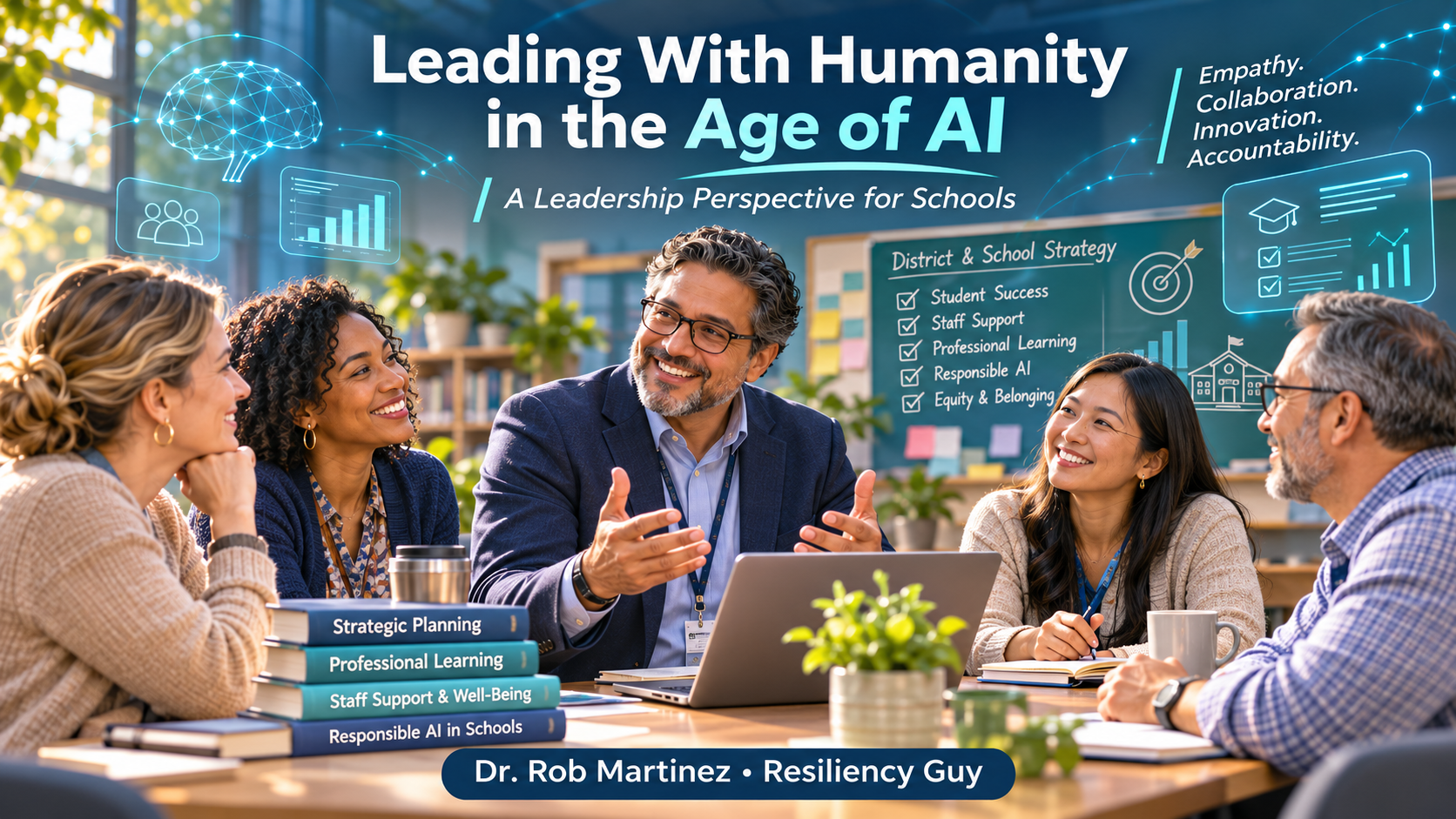
Relationships first, technology second
Helping children grow and learn is among the greatest responsibilities we share as educators, parents, and community members. Artificial intelligence is changing what is possible, but it should never change what matters most: the relationships that help children feel safe, valued, capable, and eager to learn.
At a recent presentation about humanity and AI, I found myself reflecting on a simple question: If these tools give us more time, how will we use it? To listen to a child? To encourage a teacher? To notice a student who has become quiet? Technology may create possibilities, but people give those possibilities purpose.
In my writing I have asked whether we will be consumers of technology or consumed by technology. That choice belongs to each of us. Will we each accept that reality, or will we simply accept our fate?
Curiosity and caution belong together
Our schools are wrestling with how much AI is the right amount. I understand why. Families want children protected. Teachers want tools that actually help. Leaders must consider privacy, inaccurate answers, inequity, and the temptation to substitute automated output for personal thought.
Yet fear of the unknown can also prevent us from exploring promising opportunities. We do not need to blindly embrace AI or reject it outright. We need to ask better questions, establish reasonable boundaries, and learn together. We need to work to ensure that AI is a supporting tool in our logic building, not just leading us to decisions that are not reflective of the human experience.
Make learning joyful—and meaningful
Imagine a child who discovers the excitement of investigating space exploration, writing a story, or tackling a difficult mathematics problem with thoughtful AI assistance. The excitement matters. Curiosity, imagination, perseverance, and the joy of discovery matter. A child’s expanding world may be considerably enhanced with appropriate introduction of AI models.
But the child must still read, write, reason, create, and explain. An AI-generated answer is not the same thing as learning. We should encourage students to ask: What did I think first? How did this tool challenge my thinking? What can I now do on my own?
Learning does not have to be joyless to be rigorous. Nor should AI eliminate every productive struggle.
Use screens for value, not simply time
The debate over screen time is important, especially for younger children. But recreational scrolling, reading with guidance, and designing an original project are not identical experiences. We need to consider screen time and screen value, while honoring age-appropriate limits, movement, rest, play, and face-to-face connection.
One of my favorite questions is: When the screen turns off, what can the child now do?
Make room for the people who care for children
We should never ask teachers to carry the additional weight of innovation without considering what that innovation will simplify. If we add an initiative, what will we pause? An educator deserves preparation, mentoring, professional judgment, and time to build relationships—not simply another dashboard to look at without it providing new considerations and thoughtful approaches to improve their instruction.
AI can be a thinking partner, but it is never a scapegoat. We cannot say “the AI told me to” when a choice hurts someone. We remain responsible for verifying information, protecting children, and owning our actions.
A commitment to our humanity
I support healthy AI development because I believe it may help us teach, connect, and serve children better. I also believe the test of success will not be how much technology we introduce, but whether students become more capable, creative, compassionate, independent, and resilient. AI that is introduced without being carried forward in humanity will also miss the mark. We must be conscious in our application of AI.
Artificial intelligence may expand our capabilities. Let us make sure it never diminishes our humanity.
Let the lives we help others live be the measure of our success.
Dr. Rob Martinez – Resiliency Guy – A 38 – year professional educator, author and speaker is available for Keynote addresses and professional development for your team. He is the author of “Recipes for Resilience, Nurturing Perseverance in Students and Educators” and “The Story of Sparkle and Shine, Never Forget, 2nd Edition” both of which are available on Amazon.


Leave a Reply