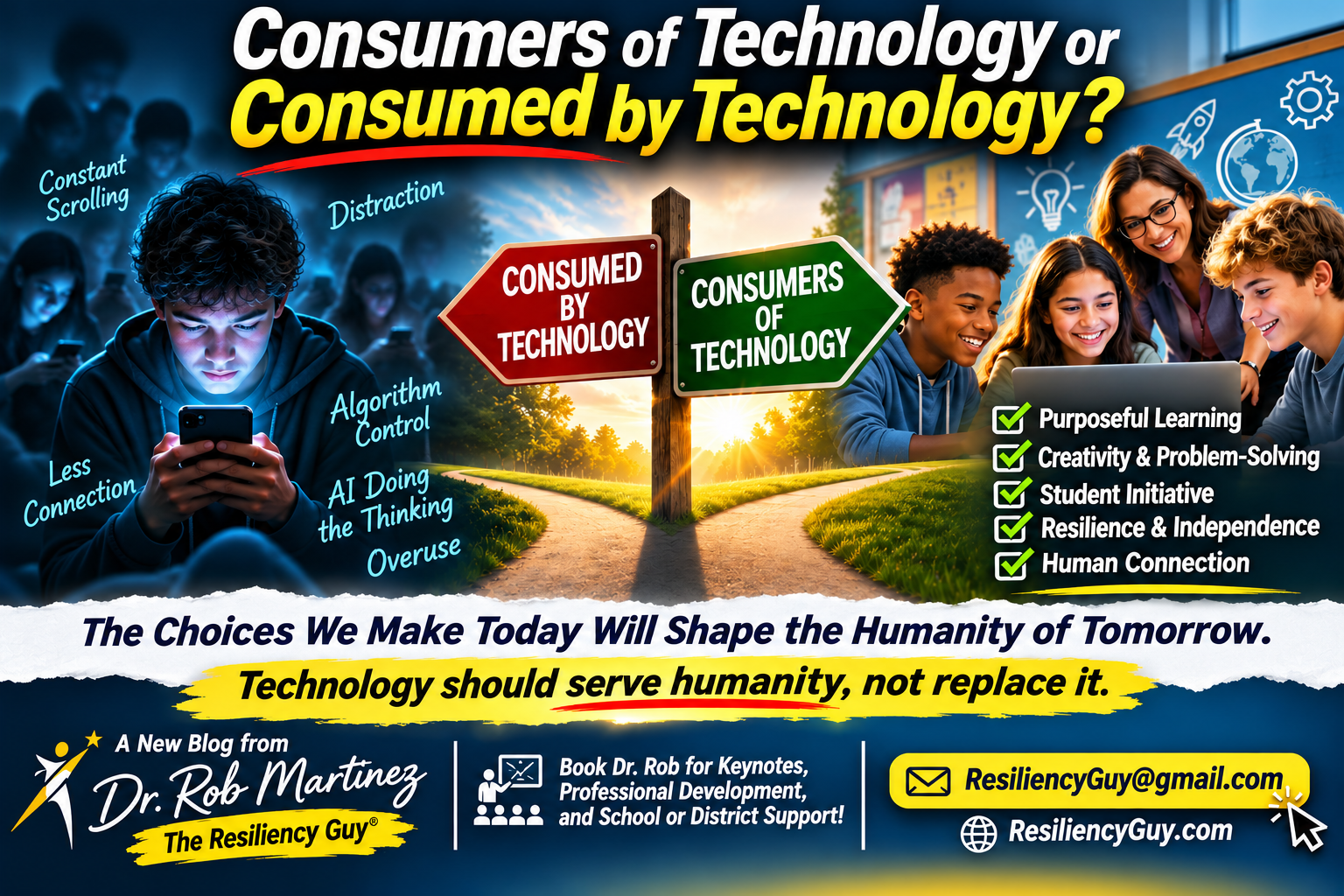
The Choices We Make Today Will Shape the Humanity of Tomorrow
By Dr. Rob Martinez – Resiliency Guy
Technology is an incredible thing.
Think about it. We live in a world where students can access libraries of information in seconds, explore the surface of Mars without leaving their classrooms, communicate with people on the other side of the globe, and use artificial intelligence to help them solve problems that once seemed unimaginable.
As educators, we should celebrate these advancements. We should embrace opportunities to help students learn, grow, create, innovate, and develop the skills they will need to thrive in a rapidly changing world.
But I believe we must ask ourselves a critically important question:
Are we teaching our children to be good consumers of technology, or are we allowing them to become consumed by technology?
There is a tremendous difference between the two.
And that difference may ultimately determine whether technology helps us build a stronger, more attentive and focused, more resilient, more compassionate society or gradually diminishes the very humanity that makes us who we are.
When Technology Becomes the Driver Instead of the Tool
Throughout my career in public education, I have witnessed extraordinary changes in the tools available to teachers and students. From the earliest classroom computers to today’s sophisticated artificial intelligence systems, the possibilities for improving teaching and learning have continued to expand.
But I’ve also learned something that has remained constant throughout those changes.
The most important technology in any classroom is still the human connection between a teacher and a student.
A teacher who recognizes that a child is struggling. A teacher who notices when a student hasn’t smiled all morning. A teacher who knows when to challenge a student, when to offer encouragement, and when to simply listen. A teacher who is skilled at engaging a student, offering stimulating instruction, and has the nuance to support the individual learnings of each student.
No computer program, algorithm, or artificial intelligence platform should replace that authentic relationship.
Unfortunately, there are signs that we are sometimes allowing technology to dictate our behaviors rather than intentionally determining how technology can improve our lives.
Consider a few examples.
The student who cannot disconnect. A young person spends hours scrolling through social media, watching short videos, and responding to notifications. Their attention is constantly being redirected, fragmented and diminished, not necessarily toward what is meaningful or important, but toward whatever an algorithm determines will keep them engaged. Instead of developing their own interests, they may increasingly consume interests selected for them and are bombarded with distractions that disallow their attention and focus to grow naturally and with purpose.
The classroom where the screen becomes the teacher. Students spend significant portions of their instructional day interacting with digital programs while opportunities for discussion, collaboration, creativity, and meaningful relationships diminish. Technology may deliver information efficiently, but delivering information is not the same as developing understanding. In far to many cases technology leads without real guidance or support from the teacher.
The parent competes with and often loses to a device for attention. Families sit together at dinner, but everyone is looking at a different screen. Conversations become shorter. Opportunities to listen, laugh, disagree respectfully, and learn from one another are lost. We may be more digitally connected than ever before while becoming less attentive and connected to the people sitting beside us.
The student who allows artificial intelligence to do the thinking. A student enters an assignment into an AI platform and receives a beautifully written response in seconds. The assignment gets completed, but did the student learn? Did they wrestle with an idea, make a mistake, reconsider their thinking, or develop the resilience, confidence and resources that come from accomplishing something difficult?
The educator is overwhelmed by technology. Teachers are introduced to one new platform after another, each promising greater efficiency, better data, or improved student outcomes. Yet without sufficient training, support for them as individuals, thoughtful implementation, and professional discretion, these tools can create additional and competing demands rather than meaningful improvements that truly support student growth and empowerment.
These examples are not arguments against technology.
They are reminders that the purpose of technology should never be simply to increase our consumption of technology.
Its purpose should be to improve our lives, to help us grow, to develop the skills we need to persevere and reach new potential as humans.
Technology Should Empower Learning, Not Replace It
Imagine a classroom where technology helps a struggling reader discover the joy of understanding a story.
Imagine children who are becoming empowered to use technology to advance their personal thinking, increase their attention skills, and expand their personal resilience.
Imagine a student who has difficulty expressing ideas in writing using an appropriate digital tool to organize their thoughts, develop their voice, and communicate with greater confidence.
Imagine students being so immersed in thought and learning by using technology to explore mathematical concepts, design engineering solutions, create original artwork, investigate scientific discoveries, or develop skills in career and technical education.
Imagine a child who has never traveled outside their community experiencing the wonders of another culture through a virtual learning experience, followed by a thoughtful classroom conversation about what they discovered.
These are examples of technology working as it should, for us, not as us.
Technology is not the destination. It is the vehicle.
The destination is greater understanding, more sustained attention and focus, stronger skills, increased confidence, deeper curiosity, enhanced resilience and the development of young people who are prepared to contribute meaningfully to their communities.
And perhaps most importantly, technology should help students develop the initiative to guide their own learning.
We should want students who ask questions, challenge assumptions, explore possibilities, and pursue interests that inspire them.
Not simply students who become exceptionally proficient at following prompts, clicking buttons, and waiting for the next digital instruction.
The goal should be to develop independent thinkers, not dependent users.
Artificial Intelligence: A Powerful Assistant, but Not the Educator
Artificial intelligence represents one of the most significant technological advancements of our time.
Its potential to support education is extraordinary.
AI can help educators explore instructional strategies, differentiate instruction, implement strategies to address targeted needs, develop lesson materials, identify possible learning gaps, provide accessibility supports, and offer students additional opportunities to practice and explore challenging concepts.
It may also help reduce administrative demands, giving teachers more time to do what they do best: engage, teach, connect, encourage, foster a love of learning and inspire.
But there must be an essential understanding as we move forward.
Artificial intelligence may recommend strategies and tools. Educators must decide.
The professional judgment of a well-prepared educator should never be surrendered to an algorithm.
Teachers must be provided with professional development to enhance their skills and must remain responsible for determining what their students need, what instructional approaches are appropriate, how learning is assessed, and when technology is helping or hindering student development. If we do this, we are working toward increasing a teacher’s efficacy.
An AI platform may identify a pattern in student performance. But the supported and well-trained teacher understands the child behind the data and can become an informed user of technology.
A digital assessment may indicate that a student is struggling with reading comprehension. But the teacher may know that the student recently experienced a family crisis, is learning English, or simply needs additional encouragement and a different instructional approach.
Data can inform decisions.
It cannot replace wisdom, compassion, or professional judgment.
As school districts consider adopting new technologies, I believe they should consistently ask:
- Does this technology support a clearly identified educational purpose?
- Does this technology help us solve a problem that is limiting the success of our student with our chosen curriculum?
- Does it strengthen our teacher’s ability to meet students’ needs?
- Does it support our families of our children in helping them in their efforts?
- Does it provide support and skills directly to children to advance their metacognitive approach to learning?
- Does it encourage critical thinking, creativity, collaboration, and independence?
- Are student privacy, safety, accessibility, and developmental needs protected?
- Can educators evaluate, question, modify, or discontinue its recommendations?
- Most importantly, does it strengthen or diminish the human capacity and relationships essential to learning?
If we cannot answer these questions with confidence, perhaps we are not yet ready to introduce that technology into our classrooms.
Innovation without intentionality is not necessarily progress.
Parents Must Remain in the Driver’s Seat
Our responsibility to help children become thoughtful consumers of technology does not end when the school day concludes.
Parents and caregivers play an equally important role.
And I recognize that this is not always easy.
Today’s families are navigating a digital environment that is changing faster than many of us can fully understand. Social media, gaming, streaming platforms, smartphones, and artificial intelligence are becoming increasingly integrated into children’s daily experiences. These issues combined with the natural challenges of growing up have made it even more difficult to develop sustained attention and focus for children.
But just because technology is available does not mean that unlimited access is appropriate.
As adult users of technology, we need self-awareness of its impact on us. Children need guidance from adults. They need boundaries. They need opportunities to develop self-regulation and understand that not every notification requires an immediate response.
They also need adults who model the behaviors we hope to develop.
We cannot reasonably expect children to put their phones away during dinner if we are unwilling to do the same.
We cannot encourage meaningful conversation while constantly checking our own devices.
And we cannot expect children to develop healthy relationships with technology without helping them understand when to use it, why to use it, and when to walk away. We too must recognize that we may have lost something in our own humanity due to the distractions that misuse of technology may have created for us. This self-actualization is an important step in our personal development.
Appropriate guardrails should reflect a child’s age, developmental readiness, individual needs, and family circumstances.
For younger children, that may mean greater supervision, carefully selected educational content, and substantial opportunities for play, conversation, movement, and hands-on exploration.
For adolescents, it may mean shared expectations and conversations around social media, sleep, privacy, digital citizenship, meta-cognitive training and responsible use of artificial intelligence.
As children mature, our goal should be to gradually transfer responsibility to them.
After all, our goal is not to simply raise children who can follow rules.
We are raising future adults who must learn to make thoughtful decisions when no one is standing beside them or when they are leading others.
What About Resilience?
As the Resiliency Guy, I often return to the importance of helping children develop the skills to navigate challenges, overcome adversity, and recognize their own capacity to succeed.
Technology can certainly support that development.
It can provide skill enhancement, encouragement, individualized practice, opportunities for reflection, and access to learning experiences that might otherwise be unavailable.
But resilience also requires something that technology cannot simply provide on demand.
It requires experience.
The experience of struggling with a difficult problem, and the development of problem-solving skills to move forward in their thinking.
The experience of making a mistake and trying again, and again, and again, while understanding that mistakes are opportunities for learning.
The experience of working through disagreement with another person, and the process of perspective building in order to evolve one’s thinking beyond a fixed mindset.
The experience of being disappointed, learning to regulate our emotions, and discovering that we can move forward.
When technology eliminates every obstacle, supplies every answer, or immediately resolves every frustration, we risk removing opportunities for children to develop perseverance, resourcefulness, confidence, and yes, resilience.
Sometimes the most valuable learning occurs when the answer is not immediately available.
Sometimes students need to sit with uncertainty, ask another question, collaborate with a classmate, or discover a solution through trial and error.
We must be careful not to confuse making learning easier with making learning better.
Technology should help students develop resilience, not insulate them from every experience that builds it.
Keeping Humanity at the Center of Innovation
I believe the next great advancement in education will not necessarily be the development of another sophisticated technological platform.
It may be our ability to determine how to use these remarkable tools while preserving and strengthening human experiences that help students grow their personal skills and helps to make education meaningful.
Think about the skills we want our children to develop.
We want them to have sustained attention for learning, read critically and for entertainment, write and communicate thoughtfully, understand and be able to apply mathematics, explore science, appreciate the arts, and develop the technical skills necessary to pursue their dreams. As they do this and find success through adversity and learning they are also building their resilience.
But we also want them to demonstrate kindness.
We want them to understand and be empathetic.
We want them to recognize when someone needs help and be willing to act in ways to help others.
We want them to collaborate with people who think differently, resolve conflicts peacefully, and understand that their actions can positively influence the lives of others.
These qualities cannot be measured solely through the number of assignments completed, digital badges earned, or hours spent engaging with a learning platform.
They are developed through relationships, experiences, reflection, guidance, and opportunities to contribute to something larger than ourselves.
In my children’s book, The Story of Sparkle and Shine: Never Forget, I encourage young people to SPARKLE by spreading positive acts regarding kind, loving encounters, and to SHINE by significantly helping increase niceness everywhere.
Imagine using technology to amplify those behaviors.
Students could collaborate with children in another community to address a local challenge. They could use digital storytelling to celebrate acts of kindness. They could design solutions that make their schools more welcoming, accessible, and inclusive.
In these examples, technology is serving humanity, humanity is not serving technology.
That is the distinction we must protect.
A Call to Educators, Parents, and Leaders
As we move forward into an increasingly technological future, I hope we will resist the temptation to measure progress simply by the number of devices in our classrooms, the sophistication of our software, or the speed at which artificial intelligence can generate a response.
Instead, let’s measure progress by what our children are becoming.
Are they more curious?
Are they more attentive?
Are they more confident?
Are they more capable of solving problems independently?
Are they developing meaningful relationships?
Are they learning to demonstrate kindness, compassion, and respect?
Are they prepared to use their knowledge and skills to make their communities better places?
And are they developing the resilience necessary to navigate a world that will undoubtedly continue to change?
These are the outcomes that matter.
School leaders must establish thoughtful expectations for technology adoption and provide educators with the training, time, and professional authority to use these tools responsibly.
Teachers must remain empowered to determine when technology enhances instruction and when students would benefit more from a conversation, a hands-on experience, a collaborative project, or simply the opportunity to think.
Parents must remain actively involved in helping their children develop healthy digital habits and understand that technology should be assistive in its endeavors, not only a distraction from learning. In fact, technology is only one part of a meaningful and balanced life.
And students must increasingly learn that they can use technology to assist them, to control their relationship with technology rather than allowing technology to control them.
The Choice Is Ours
I am optimistic about the future of technology in education.
I believe artificial intelligence and other emerging innovations can help us create extraordinary opportunities for students, educators, and families.
But optimism should never be confused with the absence of responsibility.
We must remain intentional.
We must remain thoughtful.
And above all, we must remain human.
Because the ultimate measure of educational progress is not how technologically advanced our classrooms become.
It is how effectively we help children grow into capable, compassionate, resilient human beings who can think for themselves, care for others, and contribute positively to the world around them.
I often share a simple philosophy that has guided my work throughout my career:
“Let the lives we help others live be the measure of our success.”
Perhaps that philosophy should also guide how we embrace technology.
If our innovations help children live better lives, pursue meaningful learning, build stronger relationships, and discover their capacity to make a positive difference, then we are moving in the right direction.
But if those same innovations begin to replace human connections, discourage independent thinking, lessen our ability to be attentive, concentrate or focus, or diminish our capacity for compassion, then we must have the courage to reconsider our path.
Let’s raise a generation of thoughtful consumers of technology, not a generation consumed by technology.
Our children deserve nothing less.
Dr. Rob Martinez – Resiliency Guy
Educator | Author | Leadership Consultant | Advocate for Resilience
Never Give Up!



Leave a Reply